The MSP Multi-Touch Sequence That Actually Works: Why One Cold Email Isn't Enough (And What Your 7-Touch Cadence Should Look Like)
You sent one cold email. Nobody replied. You waited a week, sent a follow-up, still nothing. So you moved on and marked the prospect as "unresponsive" in your P...
You sent one cold email. Nobody replied. You waited a week, sent a follow-up, still nothing. So you moved on and marked the prospect as "unresponsive" in your PSA or spreadsheet—because what else are you supposed to do?
Here's the problem: that prospect probably never gave you a real chance to lose. The business owner running a 35-person accounting firm doesn't have "find a new MSP" at the top of their list today. They're managing staff, handling client deadlines, and dealing with the three things that were already on fire before your email landed. One cold email—even a great one—gets skimmed, half-read, or buried under 80 other messages. It's not a rejection. It's noise.
The data on B2B outreach is consistent: most decision-makers need 5–7 meaningful touchpoints before they engage with an unknown vendor. Most MSPs give them one, maybe two. That gap is where your pipeline is leaking. This post is going to show you exactly what a 7-touch multi-channel sequence looks like for an MSP, how to space it, what to say at each stage, and—critically—how to do it in a way that feels like a professional following up, not a spammer clogging their inbox.
Why MSP Buyers Are Harder to Reach Than Most B2B Buyers
Before we get into the sequence itself, it's worth understanding why this problem is particularly acute for MSPs.
Your buyer is almost never a CTO or IT director. It's a business owner or operations manager who didn't wake up this morning thinking about their IT infrastructure. They're not actively shopping. They might be mildly dissatisfied with their current provider but not dissatisfied enough to act. That's the baseline state of most MSP prospects—passive discomfort, not active urgency.
That changes the math on outreach entirely. When someone is actively shopping, two or three touches might be enough. When they're not shopping at all, you're not competing against other MSPs—you're competing against inertia. And inertia wins unless you show up consistently, across multiple channels, with a message that speaks to something they actually care about.
The other factor: MSP switching costs feel enormous to a business owner, even when the actual transition is smooth. They're imagining downtime, data loss, retraining their staff, and explaining to their accountant why they changed vendors. Your outreach has to work hard enough to make that perceived friction feel worth overcoming. One email doesn't do that.
The 7-Touch Sequence: Channel Mix, Timing, and Messaging
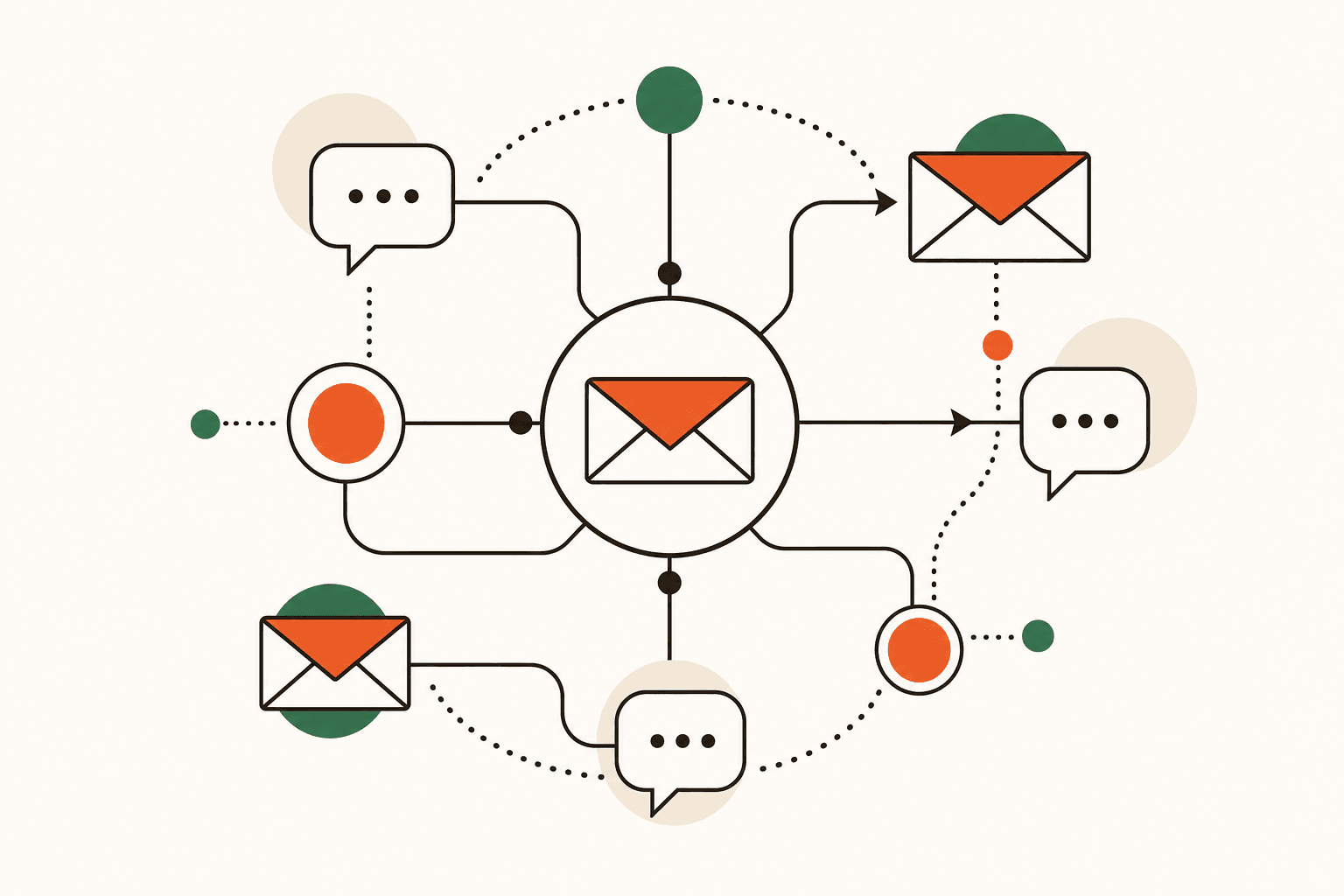
Here's what a well-built MSP outreach cadence looks like over roughly three weeks. This isn't a rigid script—it's a framework you adapt based on your target vertical and deal size.
| Touch | Day | Channel | Goal |
|---|---|---|---|
| 1 | Day 1 | Open the conversation, not close a deal | |
| 2 | Day 3 | LinkedIn connection | Put a face to the name |
| 3 | Day 5 | Add value, reference something specific | |
| 4 | Day 8 | Phone call | Real-time conversation attempt |
| 5 | Day 11 | LinkedIn message | Low-friction follow-up |
| 6 | Day 15 | The "breakup" reframe | |
| 7 | Day 21 | Phone call | Final attempt, clean close |
Touch 1 — Email: Open the Conversation
Your first email has one job: get opened and generate curiosity. Not book a meeting. Not explain your full service offering. Not list your certifications.
A first cold email for an MSP should be three to five sentences max. Name the problem you solve for businesses like theirs, reference something specific about their company (industry, size, a recent news item), and ask a single low-commitment question. Something like: "Are you currently happy with how your IT is being handled, or is that something you're actively looking to change?"
That's it. No pricing. No "we offer managed IT services, cybersecurity, and cloud solutions." Save that for later.
Touch 2 — LinkedIn Connection (Day 3)
Two days after the email goes out, send a LinkedIn connection request with a short note. Don't pitch. Don't reference the email. Just: "Hi [Name], I work with [industry] businesses in [city] on their IT—thought it'd be worth connecting."
This does two things. It puts your name in front of them a second time on a different platform, and it gives them a low-friction way to engage if the email didn't feel right. Some prospects will accept the connection and message you directly. That's a win you'd never get from email alone.
Touch 3 — Email: Add Value (Day 5)
This is where most MSPs either go silent or repeat their first email with slightly different wording. Don't do either.
Touch 3 should add something useful. A short insight relevant to their industry ("We've seen a spike in phishing attempts targeting [vertical] firms this quarter—happy to share what we're seeing"), a link to a relevant resource, or a brief case study about a similar business you've helped. If you've written a case study that speaks directly to their situation, this is a natural place to reference it.
The goal is to demonstrate that you understand their world—not just that you exist.
Touch 4 — Phone Call (Day 8)
Yes, a real phone call. If you want to know how to handle this without getting hung up on, the cold call script we've written for MSPs is worth reading before you dial. The short version: don't open with a pitch. Open with a reference to your previous outreach and a direct, honest question about whether this is worth five minutes of their time.
Voicemail is fine. Keep it under 20 seconds. Say your name, your company, why you're calling, and give them your number once—slowly.
Touch 5 — LinkedIn Message (Day 11)
If they accepted your connection request, send a brief message. If they didn't, you can still send an InMail or simply skip this touch and move to the next email.
This message should be conversational and reference something genuine—a post they made, a company update, something real. "Saw you're hiring for an office manager role—growing team usually means more to manage on the IT side. Happy to chat if timing ever makes sense." That's not spam. That's attentive.
Touch 6 — Email: The Reframe (Day 15)
This is the most underused touch in a cold sequence, and it consistently outperforms every email before it in terms of reply rate. The "breakup email" reframe isn't passive-aggressive—it's honest.
Something like: "I've reached out a few times and haven't heard back—totally understand, timing isn't always right. I'll stop following up after this, but before I do, I wanted to ask one last time: is IT something you're open to revisiting in the next quarter or two, or is it genuinely not a priority right now?"
This works because it creates a low-stakes off-ramp. Prospects who've been meaning to reply but haven't gotten around to it often respond here. And you get useful information either way—"not right now" is a signal to nurture, "we're actually looking" is a signal to push.
Touch 7 — Phone Call (Day 21)
Your final call. Brief, professional, no hard feelings. If you get voicemail, thank them for their time and let them know you'll move them to a quarterly check-in list. If you reach them live, you've got one shot—lead with the value you've demonstrated across the sequence, not a generic pitch.
What Most MSPs Get Wrong
I see two failure modes constantly, and they're almost opposite problems.
The first is giving up after one or two touches and calling the prospect "dead." You've seen this in your own pipeline—leads that went cold because nobody followed up consistently. The prospect wasn't saying no. They were saying not yet. A structured sequence captures those people instead of letting them drift to a competitor who happened to follow up at the right moment.
The second is following up with the same message repeatedly—essentially emailing someone five times to say "just checking in." That is spam. It trains prospects to ignore you and damages your domain reputation over time. Every touch in a sequence needs to add something new: a different channel, a fresh insight, a relevant case study, a direct question they haven't been asked yet.
The sequence only works if each touchpoint earns the next one.
The Operational Reality: This Only Works If You Actually Run It
Here's the thing nobody says out loud: the sequence itself isn't the hard part. Running it consistently is.
Most MSP owners start a sequence, get busy with a client escalation or a new onboarding, and the whole thing falls apart by touch three. Three weeks later they remember the prospect existed, fire off an awkward "just following up" email, and wonder why nobody responds.
If you're running outreach yourself, you need a system. At minimum: a spreadsheet or CRM with each prospect's name, company, the date of each touch, and what was sent. Most PSA tools aren't built for this—use HubSpot's free CRM, Pipedrive, or even a dedicated outreach tool like Lemlist or Instantly if you're doing volume. The tool matters less than the habit of actually using it.
If you're targeting a specific vertical—say, dental practices or accounting firms with 10–40 employees—you can build a sequence once and reuse the framework with light personalization. That's the leverage point. One well-built sequence for your target niche, run consistently against a list of 50–100 qualified prospects per month, is enough to generate real pipeline for an MSP at the $1M–$3M ARR stage.
How to Think About This at Your Stage
If you're under $1M ARR and still largely referral-dependent, your first priority isn't optimizing a 7-touch sequence—it's building the list and getting the first version running at all. Start with 20–30 prospects, run the sequence manually, and pay attention to which touches generate replies. You'll learn more from 30 real sequences than from any template.
If you're between $1M and $3M ARR and you've tried cold outreach before but it "didn't work," the honest question to ask yourself is: did you actually run a full sequence, or did you send a few emails and call it a test? Most MSPs I talk to have never completed a 7-touch sequence on more than a handful of prospects. That's not a failed channel—that's an incomplete experiment.
If you're above $3M ARR and want to scale this, the conversation shifts to delegation. Who's running the sequences? Who's qualifying the list? Who's handling the initial responses before they get to you or your sales person? At that stage, niching your outreach down to a specific vertical becomes a force multiplier—it lets you build sequences that feel hyper-relevant without requiring custom research on every prospect.
If you want a second set of eyes on your current outreach approach—what's working, what's stalling, and what to prioritize—a free 30-minute strategy call is the fastest way to get a clear answer. We work with MSPs at each of these stages and can usually identify the exact bottleneck in the first conversation.
The Takeaway
One cold email isn't a strategy. It's a lottery ticket. A structured 7-touch sequence across email, phone, and LinkedIn—with each touch adding something new—is what separates MSPs who build predictable pipeline from the ones who stay stuck waiting on referrals.
The mechanics aren't complicated. The discipline to run it consistently, against the right list, with messaging that actually speaks to a business owner's concerns—that's the real work. If you'd rather have a team handle the outreach and deliver booked appointments directly to your calendar, take a look at how Behold Digital works and what we guarantee. But if you're building this yourself, the sequence above is a solid place to start.
Ready to Build a Real Pipeline?
A 30-minute call with Gavin to discuss your marketing situation and see if we're a good fit. I run marketing campaigns for MSPs - no pitch, just an honest conversation about what you need.