The MSP Content Repurposing System That Turns One Blog Post Into 12 Sales Conversations: Why Most MSPs Write Once and Abandon the Asset
You wrote 1,400 words on why layered security beats a single firewall, published it, shared it once on LinkedIn, and moved on to the next fire. Three weeks late...
You wrote 1,400 words on why layered security beats a single firewall, published it, shared it once on LinkedIn, and moved on to the next fire. Three weeks later, you can't remember the last time it came up in a sales call. Meanwhile you're still opening every discovery call with the same pitch you've given 200 times, still sending the same generic follow-up email after every proposal, still relying on referrals because "content marketing didn't work" for your MSP.
Here's what actually happened: content marketing didn't fail you. You built one asset and expected it to do the job of twelve.
The math on this matters more than most MSP owners realize. If it takes you four hours to research, write, and edit a decent blog post, and you publish it once and never touch it again, you've spent four hours generating maybe 40 pageviews and zero sales conversations. Do that monthly for a year and you've spent 48 hours for a folder of blog posts nobody reads twice. That's the version of content marketing that gets MSP owners to conclude "content doesn't generate leads," when what actually happened is they wrote once and abandoned the asset.
The Real Problem: You're Treating Content Like a Deliverable, Not a Pipeline Input
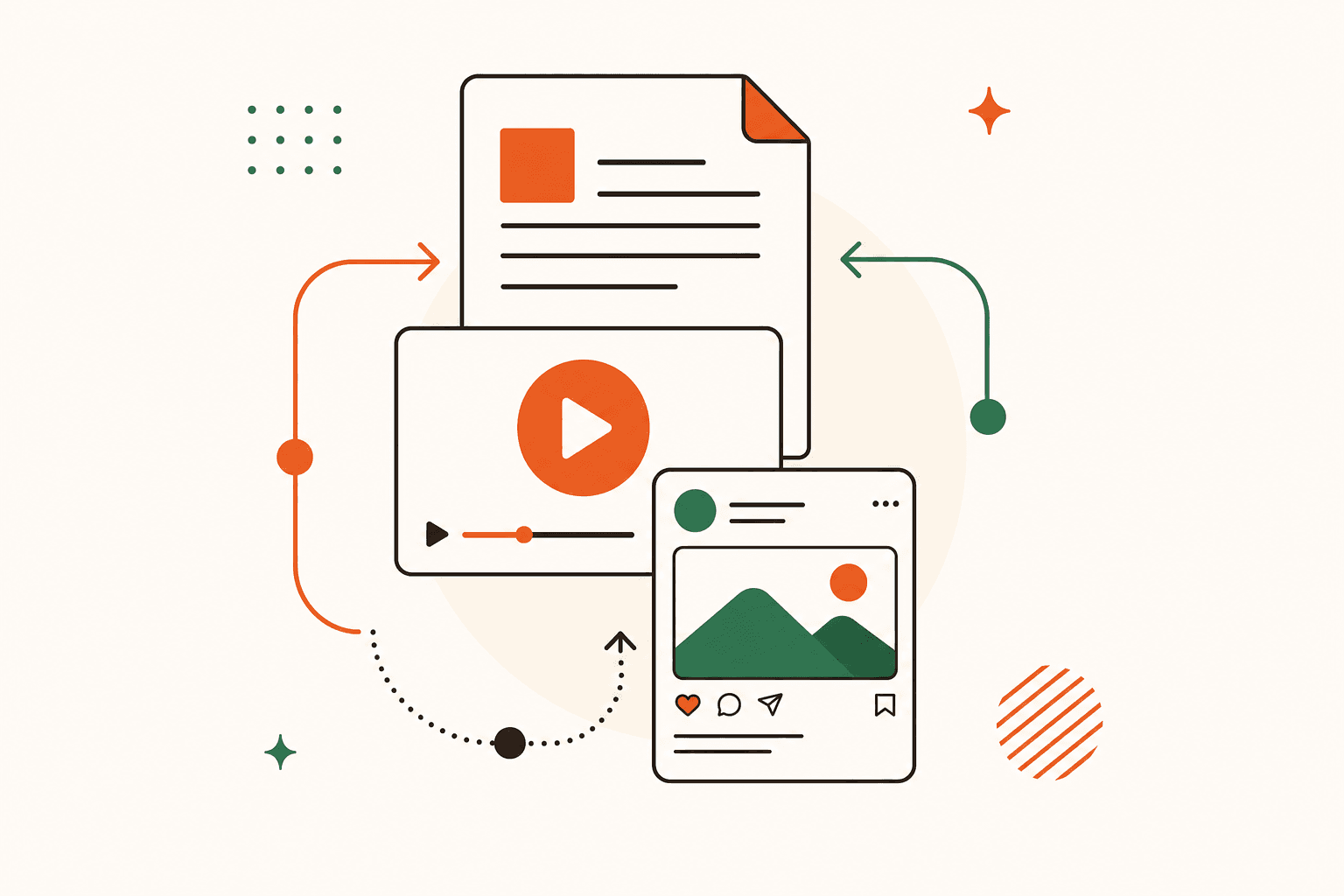
Most MSP owners think about content the way they think about a client deliverable — write it, ship it, done. But a blog post isn't the finish line. It's raw material. One well-researched post on, say, why manufacturing clients need OT/IT network segmentation should show up in your world at least six or seven more times after publication: as a LinkedIn post breaking down one stat from it, as a follow-up email to a stalled prospect, as a slide in your discovery call deck, as an answer to an objection during a QBR, as an email nurture touch for prospects who aren't ready to buy yet.
If you're only getting one use out of a piece of content, you're leaving 80% of its value on the table. And for an MSP owner who's already stretched between managing the NOC, handling escalations, and trying to close deals, that's not a minor inefficiency — that's dozens of hours a year spent creating assets that never touch your pipeline.
The 12-Touch Repurposing Framework
Here's the system: one core piece of content, repurposed across the channels where your actual buyers — business owners, office managers, practice administrators, not IT people — are paying attention.
Start with a pillar post built around a real sales objection or client question. Not "5 Benefits of Managed IT Services" — that's generic enough that a dentist's website could run it word for word. Something specific: "Why Your Cyber Insurance Premium Just Went Up (And What Underwriters Are Actually Checking For)" or "What Happens to Your Client Data When Your MSP Gets Acquired." These are things your prospects are actually anxious about, and they're specific enough to your world that they'd never show up on a marketing agency's blog.
From that single pillar post, here's where it goes:
| Channel | Format | Purpose |
|---|---|---|
| LinkedIn (owner's personal profile) | 3 posts pulling individual stats or stories from the piece | Builds trust with prospects who research you before a call |
| Email nurture sequence | 1–2 emails to prospects who went quiet after a proposal | Re-engages without a "just checking in" email |
| Discovery call talking point | Reference in the first 5 minutes of a call | Establishes expertise before you pitch anything |
| Sales follow-up | Send the link post-call as supporting material | Gives prospects something to share internally with decision-makers |
| QBR agenda item | Use as a discussion prompt with existing clients | Opens upsell conversations without sounding like a pitch |
| Cold outreach reference | One line in a cold email or call opener | Gives you a reason to reach out that isn't "checking in" |
| Google Business Profile post | Short excerpt with a link | Improves local visibility, reinforces expertise for local searchers |
That's seven channels, and most pieces of decent content can support 10-12 individual touches once you break them into pieces. A single 1,500-word post on ransomware recovery timelines can become three LinkedIn posts (one on backup testing frequency, one on RTO/RPO in plain English, one client story), two email sequence touches, a QBR talking point, and a line in your cold call script. That's eight touches from one writing session.
If you're building a cold outreach motion, this is exactly the kind of material that makes a cold call script actually land instead of getting hung up on — because you're not calling with nothing, you're calling with a specific insight you can reference in the first fifteen seconds.
What Most MSPs Get Wrong
The mistake I see constantly: MSP owners write content that sounds like a services page, then wonder why it doesn't get shared or referenced. "We provide 24/7 monitoring and support for businesses of all sizes" isn't content — it's a rewritten homepage. Nobody repurposes that into a LinkedIn post because there's nothing in it worth extracting.
The second mistake, which is just as common: writing genuinely good content and then treating LinkedIn as the only repurposing channel. You post it once, get 40 likes from other people in the MSP space (who aren't your buyers), and call it done. Your actual prospects — the office manager at a 35-person law firm, the practice administrator at a healthcare group — aren't scrolling LinkedIn looking for your post. They see it because you referenced it on a call, or because it showed up in a follow-up email after your proposal went quiet, or because it came up in a QBR when they asked why their premiums went up.
The channels where B2C content lives — organic social reach, viral posts — mostly don't apply here. Your buyer isn't discovering you through an algorithm. They're discovering you through a referral, a Google search when something breaks, or a conversation where you happened to reference something specific and useful. That's why sales-adjacent repurposing (discovery calls, follow-ups, QBRs) usually outperforms pure social distribution for MSPs specifically — the audience is small, high-intent, and reachable through channels you already control.
How to Think About This for Your Stage
If you're under $1.5M ARR and still closing most deals through referrals, don't start with a 12-touch content calendar. You don't have the sales volume yet to justify the system overhead. Instead, pick your three most common sales objections — the things prospects say on every discovery call — and write one piece of content addressing each. Then make sure every salesperson (probably just you) references those three pieces by name during calls. That alone will outperform a content calendar with no distribution plan.
If you're between $1.5M and $3M ARR and running a handful of active sales conversations at any given time, this is where repurposing pays off fastest. You have enough proposal-stage deals that follow-up email sequences built from existing content will measurably move the needle. Build one pillar post a month, break it into the seven-channel structure above, and track which pieces actually get referenced in closed-won deals.
If you're above $3M ARR with a dedicated salesperson or a small marketing function, the constraint usually isn't content creation — it's that your content and your sales process live in separate worlds. Your salesperson doesn't know the blog exists, or your marketing person writes in a vacuum with no visibility into what objections are actually killing deals. Fix that gap before producing more content. A content audit paired with a sales debrief usually surfaces this in under an hour.
Questions worth asking yourself before you write the next post:
- What's the one objection that comes up in almost every discovery call, and have I ever written anything that addresses it head-on?
- When was the last time I referenced my own content during a sales call?
- If a prospect went quiet after a proposal, do I have anything specific to send them that isn't "just checking in"?
- Does my sales process (or my salesperson) even know what content exists?
If you're not sure how to answer these, that's usually the sign the bottleneck isn't content volume — it's the system connecting content to conversations. That's worth a closer look before you write anything else.
The Bigger Shift
This connects to a pattern I see across most of the MSP marketing mistakes worth fixing: the content itself is rarely the problem. Weak proposals often trace back to not addressing the objections prospects actually have — the same objections a well-built content library should already be answering. And if you've niched down into a specific vertical, as more MSPs are finally doing, your repurposing gets even more efficient — one piece of content about compliance requirements for a specific industry can carry you through months of touches with prospects in that exact vertical, because you're not writing generically, you're writing for a room of people with the same specific fears.
The MSPs who treat content as a system — writing once, using twelve times — build pipeline steadily without spending more hours writing. The MSPs who write once and move on stay stuck wondering why "content doesn't work," while quietly burning hours on assets nobody but Google ever sees.
If you're producing content and it's not showing up anywhere in your actual sales process, that's usually the first bottleneck worth fixing — not writing more, just using what you've already built. A free 30-minute strategy call is usually enough to map out exactly where your existing content should be showing up and where the gaps are costing you conversations you should already be having.
Ready to Build a Real Pipeline?
A 30-minute call with Gavin to discuss your marketing situation and see if we're a good fit. I run marketing campaigns for MSPs - no pitch, just an honest conversation about what you need.